
The Kuiper Belt is a disk-shaped region past the orbit of Neptune extending roughly from 30 to 50 AU from the Sun containing many small icy bodies. It is now considered to be the source of the short-period comets.
Occasionally the orbit of a Kuiper Belt object will be disturbed by the interactions of the giant planets in such a way as to cause the object to cross the orbit of Neptune. It will then very likely have a close encounter with Neptune sending it out of the solar system or into an orbit crossing those of the other giant planets or even into the inner solar system.
There are presently nine known objects orbiting between Jupiter and Neptune (including 2060 Chiron (aka 95 P/Chiron) and 5145 Pholus; see the MPC’s list). The IAU has designated this class of objects as Centaurs. These orbits are not stable. These objects are almost certainly “refugees” from the Kuiper Belt. Their future fate is not known. Some of these show some cometary activity (ie, their images are a little fuzzy indicating the presence of a diffuse coma). The largest of these is Chiron which is about 170 km in diameter, 20 times larger than Halley. If it ever is perturbed into an orbit that approaches the Sun it will be a truly spectacular comet.
Curiously, it seems that the Oort Cloud objects were formed closer to the Sun than the Kuiper Belt objects. Small objects formed near the giant planets would have been ejected from the solar system by gravitational encounters. Those that didn’t escape entirely formed the distant Oort Cloud. Small objects formed farther out had no such interactions and remained as the Kuiper Belt objects.
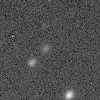
Several Kuiper Belt objects have been discovered recently including 1992 QB1 and 1993 SC (above). They appear to be small icy bodies similar to Pluto and Triton (but mostly smaller). There are more than 800 known trans-Neptunian objects (as of early 2004); see the MPC’s list. Many orbit in 3:2 resonance with Neptune (as does Pluto). Color measurements of some of the brightest have shown that they are unusually red. In late 2002, a Kuiper Belt object over 1000 km in diameter was discovered and provisionally designated 2002 LM60 “Quaoar”. In early 2004 an even larger one, 2004 DW, was found (its size isn’t well known yet, but it’s almost certainly smaller than Pluto). And in late 2005 the discovery of 2003 UB313 (now officially named “Eris”) was announced; it is very likely somewhat larger than Pluto.
It is estimated that there are at least 35,000 Kuiper Belt objects greater than 100 km in diameter, which is several hundred times the number (and mass) of similar sized objects in the main asteroid belt.
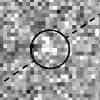
A team of astronomers led by Anita Cochran report that the Hubble Space Telescope has detected extremely faint Kuiper Belt objects (left). The objects are very small and faint perhaps only 20 km or so across. There may be as many as 100 million such comets in low-inclination orbits and shining brighter than the HST’s magnitude-28 limit. (A follow-up HST observation failed to confirm this observation, however.)
Spectra and photometric data have been obtained for 5145 Pholus. Its albedo is very low (less than 0.1). Its spectra indicates the presence of organic compounds, which are often very dark (e.g. the nucleus of Comet Halley).
Some astronomers believe that Triton, Pluto and its moon Charon are merely the largest examples of Kuiper Belt objects (Pluto can still be considered a member of the Kuiper Belt in addition to its classification as a “dwarf planet”).
In 1950 Jan Oort noticed that
- no comet has been observed with an orbit that indicates that it came from interstellar space,
- there is a strong tendency for aphelia of long period comet orbits to lie at a distance of about 50,000 AU, and
- there is no preferential direction from which comets come.
From this he proposed that comets reside in a vast cloud at the outer reaches of the solar system. This has come to be known as the Oort Cloud. The statistics imply that it may contain as many as a trillion (1e12) comets. Unfortunately, since the individual comets are so small and at such large distances, we have no direct evidence about the Oort Cloud.
The Oort Cloud may account for a significant fraction of the mass of the solar system, perhaps as much or even more than Jupiter. (This is highly speculative, however; we don’t know how many comets there are out there nor how big they are.)
In 2004, the discovery of an object known as 2003 VB12 “Sedna” was announced. Its orbit is intermediate between the Kuiper Belt and what was previously thought to be the inner part of the Oort Cloud. Perhaps this object is the first of a new class of “inner Oort Cloud” objects.
But Kuiper Belt and the Oort Cloud are more than distant curiosities. They are relatively pristine remnants of the nebula from which the entire solar system was formed. Their composition and distribution places important constraints on models of the early evolution of the solar system.
More about Kuiper Belt objects
- Kuiper Belt Home Page by David Jewitt
- Quaoar, one of the largest non-planets
- 2004 DW,the biggest KBO so far?
- Chiron info and resources
- Chiron Perihelion Campaign from NSSDC
- a chart showing the positions of some of these objects
- Beyond Pluto, from Phil Plait’s excellent Bitsize Astronomy site
- press release on HST’s Kuiper Belt images
- list of TNOs
- list of Centaurs
- the Kuiper Belt’s outer edge detected?
Open Issues
- The very existence of the Oort Cloud is only a working hypothesis. Our only evidence is very indirect.
- HST’s recent images seem to confirm the existence of the Kuiper Belt. But how many objects are there? What are they made of?
- New Horizons will go to a KBO after it passes Pluto (assuming its funding continues!).