
A meteor is a bright streak of light in the sky (a “shooting star” or a “falling star”) produced by the entry of a small meteoroid into the Earth’s atmosphere. If you have a dark clear sky you will probably see a few per hour on an average night; during one of the annual meteor showers you may see as many as 100/hour. Very bright meteors are known as fireballs; if you see one please report it.
Meteor History
Meteor showers can be very impressive. Samuel Taylor Coleridge’s famous lines from The Rime of the Ancient Mariner:
The upper air burst into life!
And a hundred fire-flags sheen,
To and fro they were hurried about!
And to and fro, and in and out,
The wan stars danced betweenAnd the coming wind did roar more loud,
And the sails did sigh like sedge;
And the rain poured down from one black cloud;
The Moon was at its edge
may have been inspired by the Leonid meteor shower that he witnessed in 1797.
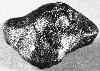
Meteorites are bits of the solar system that have fallen to the Earth. Most come from asteroids, including few are believed to have come specifically from 4 Vesta; a few probably come from comets. A small number of meteorites have been shown to be of Lunar (23 finds) or Martian (22) origin.
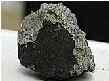
One of the Martian meteorites, known as ALH84001 (left), is believed to show evidence of early life on Mars.
Though meteorites may appear to be just boring rocks, they are extremely important in that we can analyze them carefully in our labs. Aside from the few kilos of moon rocks brought back by the Apollo and Luna missions, meteorites are our only material evidence of the universe beyond the Earth.
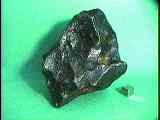
Iron
primarily iron and nickel; similar to type M asteroids
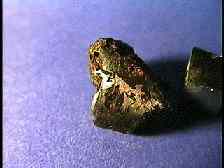
Stony Iron
mixtures of iron and stony material like type S asteroids
Chondrite
by far the largest number of meteorites fall into this class; similar in composition to the mantles and crusts of the terrestrial planets
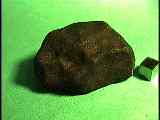
very similar in composition to the Sun less volatiles; similar to type C asteroids
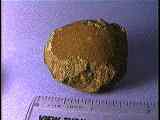
Achondrite
similar to terrestrial basalts; the meteorites believed to have originated on the Moon and Mars are achondrites
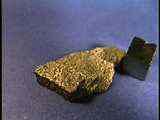
A “fall” means the meteorite was witnessed by someone as it fell from the sky. A “find” means the meteorite was not witnessed and the meteorite was found after the fact. About 33% of the meteorites are witnessed falls. The following table is from a book by Vagn F. Buchwald. Included are all known meteorites (4660 in all, weighing a total of 494625 kg) in the period 1740-1990 (excluding meteorites found in Antarctica).
| Meteorite Statistics | ||||
|---|---|---|---|---|
| Type | Fall % | Find % | Fall Weight | Find Weight |
| Stony | 95 | 79.8 | 15200 | 8300 |
| Stony-Iron | 1 | 1.6 | 525 | 8600 |
| Iron | 4 | 18.6 | 27000 | 435000 |
A very large number of meteoroids enter the Earth’s atmosphere each day amounting to more than a hundred tons of material. But they are almost all very small, just a few milligrams each. Only the largest ones ever reach the surface to become meteorites. The largest found meteorite (Hoba, in Namibia) weighs 60 tons.
The average meteoroid enters the atmosphere at between 10 and 70 km/sec. But all but the very largest are quickly decelerated to a few hundred km/hour by atmospheric friction and hit the Earth’s surface with very little fanfare. However meteoroids larger than a few hundred tons are slowed very little; only these large (and fortunately rare) ones make craters.
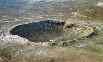
A good example of what happens when a small asteroid hits the Earth is Barringer Crater (a.k.a. Meteor Crater) near Winslow, Arizona. It was formed about 50,000 years ago by an iron meteor about 30-50 meters in diameter. The crater is 1200 meters in diameter and 200 meters deep. About 120 impact craters have been identified on the Earth, so far (see below).
A more recent impact occurred in 1908 in a remote uninhabited region of western Siberia known as Tunguska. The impactor was about 60 meters in diameter and probably consisting of many loosely bound pieces. In contrast to the Barringer Crater event, the Tunguska object completely disintegrated before hitting the ground and so no crater was formed. Nevertheless, all the trees were flattened in an area 50 kilometers across. The sound of the explosion was heard half-way around the world in London.
There are probably at least 1000 asteroids larger than 1 km in diameter that cross the orbit of Earth. One of these hits the Earth about once in a million years or so on the average. Larger ones are less numerous and impacts are less frequent, but they do sometimes happen and with disastrous consequences.
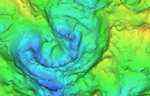
The impact of a comet or asteroid about the size of Hephaistos or SL9 hitting the Earth was probably responsible for the extinction of the dinosaurs 65 million years ago. It left a 180 km crater now buried below the jungle near Chicxulub in the Yucatan Peninsula (right).
Calculations based on the observed number of asteroids suggest that we should expect about 3 craters 10 km or more across to be formed on the Earth every million years. This is in good agreement with the geologic record. It is more difficult to compute the frequency of larger impacts like Chicxulub but once per 100 million years seems like a reasonable guess.
Here are educated guesses about the consequences of impacts of various sizes:
| Impactor Diameter (meters) | Yield (megatons) | Interval (years) | Consequences |
|---|---|---|---|
| < 50 | < 10 | < 1 | meteors in upper atmosphere most don't reach surface |
| 75 | 10 - 100 | 1000 | irons make craters like Meteor Crater; stones produce airbursts like Tunguska; land impacts destroy area size of city |
| 160 | 100 - 1000 | 5000 | irons,stones hit ground; comets produce airbursts; land impacts destroy area size of large urban area (New York, Tokyo) |
| 350 | 1000 - 10,000 | 15000 | land impacts destroy area size of small state; ocean impact produces mild tsunamis |
| 700 | 10,000 - 100,000 | 63000 | land impacts destroy area size of moderate state (Virginia); ocean impact makes big tsunamis |
| 1700 | 100,000 - 1,000,000 | 250000 | land impact raises dust with global implication; destroys area size of large state (California, France) |
Data from ‘The Impact Hazard’, by Morrison, Chapman and Slovic, published in Hazards due to Comets and Asteroids
More recent studies indicate a slightly lower frequency.
More about Meteorites
- more images
- Meteorites and their Properties, by David A. Kring (if you think you’ve found a meteorite read this)
- New England Meteoritical Services (lots of info)
- What is a Meteorite? by Paul Sipiera
- near-Earth objects from RGO
- Micrometeorites from LANL
- Meteorite and Impacts Advisory Committee, includes info and more images
- ANSMET, The Antarctic Search for Meteorites
- Arizona meteorites, including a nice clickable map of finds in Arizona
- International Meteor Organization
- Meteor Streams, a concise table of meteor shower data
- Gary Kronk’s Meteor Showers page
- the Dutch Meteor Society — info about current meteor showers (and more)
- Leonid Meteor Outburst Home Page
- SNC Meteorites
- Lunar Meteorites
- Mars Meteorites from Ron Baalke at JPL (lots of images!)
- list of Martian Meteorites
- Meteorite! magazine
- Extrasolar material in meteorites
- Americal Meteor Society including an informative two-part FAQ
- NAU Meteorite LabMeteorites for sale
- The Meteorite Market, info about meteorites and meteorite collecting and many nice images
- The Meteorite Exchange, info and more links
- R.A. Langheinrich Meteorites, includes a nice image gallery
- Meteorites.com, also includes some classification info
- Meteorite Express
- Michael Blood Meteorites
- meteorites.tv
- Aerolite.org
- Arizona Skies MeteoritesImpacts
- Asteroid and Comet Impact Hazards from NASA AMES
- Spaceguard survey
- the Spacewatch Project
- the Torino Scale of impact threat
- The Impact Catastrophe (ExInEd hypercard stack)
- Essay about the K-T Event by Calvin Hamilton of LANL
- The Probability of Collisions with Earth (also from LANL)
- text and pictures of Terrestrial Impact Craters (also from LANL)
- a teacher’s guide about Cosmic Collisions by Sally Stephens of PASP
- The Barringer Meteorite Crater, nice site with lots of information
- Tunguska Page from Southworth Planetarium
- Tunguska Home Page
- another Tunguska Home Page from the University of Bologna
- meteorites sometimes hit houses!
- Orbit Diagrams for various Near-Earth objects and comets
- tables of past and future close approaches to the Earth and Potentially Dangerous NEOs
- Asteroid 1999 AN10
- nice atlas of Terrestrial Impact Structures (with maps and images)
- another list of identified impact craters on Earth (plain text)
- Catastrophism by Philip Burns
- FIDAC (Fireball Data Center), including an online fireball report form
- Meteor Research Resources Page
- The Peekskill Fireball
- simulation of a big comet impact by Sandia
Open Issues
- Can we trace the origin of the various types of meteorites to a parent asteroid?
- Was it a comet or an asteroid that caused the Chicxulub crater in the Yucatan (and probably caused the extinction of the dinosaurs)?
- Will Spacewatch retain enough funding to finish its job of identifying all the potentially dangerous near-Earth asteroids?
- Will we find more pieces of Mars in Antarctica?
Note
Here is what President of the United States Bill Clinton had to say about the discovery of evidence for life in a meteorite from Mars:
“It is well worth contemplating how we reached this moment of discovery. More than 4 billion years ago this piece of rock was formed as a part of the original crust of Mars. After billions of years it broke from the surface and began a 16 million year journey through space that would end here on Earth. It arrived in a meteor shower 13,000 years ago. And in 1984 an American scientist on an annual U.S. government mission to search for meteors on Antarctica picked it up and took it to be studied. Appropriately, it was the first rock to be picked up that year — rock number 84001.
Today, rock 84001 speaks to us across all those billions of years and millions of miles. It speaks of the possibility of life. If this discovery is confirmed, it will surely be one of the most stunning insights into our universe that science has ever uncovered. Its implications are as far-reaching and awe-inspiring as can be imagined. Even as it promises answers to some of our oldest questions, it poses still others even more fundamental.
We will continue to listen closely to what it has to say as we continue the search for answers and for knowledge that is as old as humanity itself but essential to our people’s future.”