
Ariel (“AIR ee el”) is the twelfth of Uranus‘s known satellites:
        orbit:    190,930 km from Uranus
        diameter: 1158 km
        mass:     1.27e21 kg
Ariel is a mischievous airy spirit in Shakespeare’s The Tempest.
Discovered by Lassell in 1851.
Ariel and Titania appear quite similar though Titania is 35% larger. All of Uranus’ large moons are a mixture of about 40-50% water ice with the rest rock, a somewhat larger fraction of rock than Saturn‘s large moons such as Rhea.
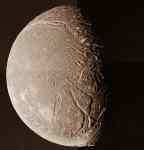
Ariel’s surface is a mixture of cratered terrain and systems of interconnected valleys hundreds of kilometers long (left, above) and more than 10 km deep. This is similar to, but much larger and more extensive than the situation on Titania. Some of the craters appear to be half-submerged. Ariel’s surface is clearly relatively young (though older than some such as Enceladus); obviously some sort of resurfacing processes have been at work. Some ridges in the middle of the valleys are interpreted as upwellings of ice.
Ariel may have been hot inside long ago, but it’s cold now. Perhaps the valleys are cracks which formed when Ariel froze.
It is actually possible to see Uranus’s 4 largest moons with an amateur telescope. But it takes a very dark sky and at least a 12 inch (30 cm) aperture.
More about Ariel
- more images
- ‘Valley World‘
Open Issues
- What caused the deep valleys and the resurfacing?