
Europa is the smallest of the Galilean moons of Jupiter, and the sixth closest natural satellite to the planet. Galileo Galilei discovered it along with Io, Ganymede and Callisto. Despite it being the smallest of the Galilean moons it is still one of the largest moons in our Solar System.
When was Europa discovered?
Europa was officially discovered by Galileo Galilei on the 8th January 1610, along with the other Galilean moons of Jupiter. However, it may have been found on 7th January. Galileo had a low-powered telescope and could not distinguish Europa from Io until 8th January.
The discovery of Europa and the other moons of Jupiter not only had astronomical but religious implications. The discovery of the Galilean moons led to the understanding that the planets in our Solar System orbit the Sun, rather than the Universe orbiting the Earth.
When Galileo first discovered Europa and the other moons of Jupiter he named them after a powerful Italian Medici family and called them the Medicean planets. Galileo named each of the moons numerically as; I, II, III, and IV. Europa was named Jupiter II. This numeric system was used until the mid-1800s when the satellites were given their mythological names. It was decided this would be best as the numerical system would become very confusing as new moons were being discovered.
How did Europa get its name?
The moon was named after Europa, daughter of the king of Tyre, a Phoenician noblewoman in Greek mythology. All Galilean satellites, Europa is named after a lover of Zeus, the Greek version of Jupiter. In Greek Mythology, Europa became a queen of Crete after being courted by Zeus.
Orbit Facts
- Europa orbits Jupiter in 3.5 days.
- The moon’s orbit is elliptical and because of this orbit Europa’s distance from Jupiter varies.
- Europa is locked in place by Jupiter’s gravity, which results in one hemisphere always facing the planet.
- Europa’s elliptical orbit causes the near side to feel Jupiter’s gravity far more than its far side.
Physical Facts
- Europa is the sixth largest moon and fifteenth largest object in the Solar System.
- Europa is the smallest of the Galilean moons discovered by Galileo.
- Europa’s surface is made of frozen water and is the smoothest in the Solar System.
- There are very few geological features (mountains or craters) on the surface of Europa.
- Europa’s most striking geological features on the surface are dark lines which criss-cross across the entire surface, called lineae. Scientists believe the lineae are created by warm ice reaching the surface and the moon’s surface opening to expose the warm layers beneath.
- The moon’s surface is estimated only to be 40 to 90 million years old; other Jupiter moons surfaces are estimated to be billions of years old.
- Europa is 4.5 billion years old, which is a lot older than its surface.
- Radiation on Europa is high at 5400 mSv (540 rem) per day and could kill a human being in one day.
- Scientists have proposed that there is a global ocean of salty water 100 km (60 mi) below the icy surface of the moon. The ocean is created by the tidal effects (tidal heating) between Jupiter and Europa are what keeps the ice in liquid form below the moon’s surface.
- If the existence of the salty ocean is proven, then it is one of the most promising places where scientists can find life in our Solar System.
- If the ocean beneath the surface does exist then, it could mean Europa has twice as much water than in Earth’s oceans.
- Europa has a thin atmosphere which is primarily made from oxygen.
- Europa’s average surface temperature is -160 °C (or −260 °F) which keeps the moon’s icy surface frozen and as hard as granite.
Expeditions to Europa Facts
- In 1973 Pioneer 10, and its sister mission Pioneer 11 (1974), both take close up measurements of Europa and the other Galilean moons around Jupiter.
- Voyager 1 takes data of Europa on a flyby of the moon in March 1979, and Voyager 2 takes further snapshots. It was the images taken by these missions which caused scientists to hypothesise about Europa having a global ocean beneath the surface.
- The Galileo space probe provided further detailed images and data captures of the Galilean moons of any space mission.
- In 2007 the New Horizon mission took further snapshots of Europa on a fly by on its way to to the outer edges of our Solar System.
- In May 2015 NASA announced the development of the Europa Clipper, whose mission is to investigate the moons hability for life.
Jupiter II
Europa (“yoo ROH puh”) is the sixth of Jupiter’s known satellites and the fourth largest; it is the second of the Galilean moons. Europa is slightly smaller than the Earth’s Moon.
        orbit:    670,900 km from Jupiter
        diameter: 3138 km
        mass:     4.80e22 kg
Europa was a Phoenician princess abducted to Crete by Zeus, who had assumed the form of a white bull, and by him the mother of Minos.
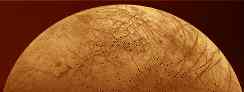
Discovered by Galileo and Marius in 1610.
Europa and Io are somewhat similar in bulk composition to the terrestrial planets: primarily composed of silicate rock. Unlike Io, however, Europa has a thin outer layer of ice. Recent data from Galileo indicate that Europa has a layered internal structure perhaps with a small metallic core.
But Europa’s surface is not at all like anything in the inner solar system. It is exceedingly smooth: few features more than a few hundred meters high have been seen. The prominent markings seem to be only albedo features with very low relief.
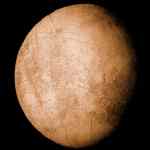
There are very few craters on Europa; only three craters larger than 5 km in diameter have been found. This would seem to indicate a young and active surface. However, the Voyagers mapped only a fraction of the surface at high resolution. The precise age of Europa’s surface is an open question.
The images of Europa’s surface strongly resemble images of sea ice on Earth. It is possible that beneath Europa’s surface ice there is a layer of liquid water, perhaps as much as 50 km deep, kept liquid by tidally generated heat. If so, it would be the only place in the solar system besides Earth where liquid water exists in significant quantities.
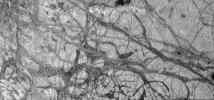
Europa’s most striking aspect is a series of dark streaks crisscrossing the entire globe. The larger ones are roughly 20 km across with diffuse outer edges and a central band of lighter material. The latest theory of their origin is that they are produced by a series of volcanic eruptions or geysers.
Recent observations with HST reveal that Europa has a very tenuous atmosphere (1e-11 bar) composed of oxygen. Of the many moons in the solar system only five others (Io, Ganymede, Callisto, Titan and Triton) are known to have atmospheres. Unlike the oxygen in Earth’s atmosphere, Europa’s is almost certainly not of biologic origin. It is most likely generated by sunlight and charged particles hitting Europa’s icy surface producing water vapor which is subsequently split into hydrogen and oxygen. The hydrogen escapes leaving the oxygen.
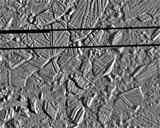
The Voyagers didn’t get a very good look at Europa. But it is a principal focus of the Galileo mission. Images from Galileo’s first two close encounters with Europa seem to confirm earlier theories that Europa’s surface is very young: very few craters are seen, some sort of activity is obviously occurring. There are regions that look very much like pack-ice on polar seas during spring thaws on Earth. The exact nature of Europa’s surface and interior is not yet clear but the evidence is now strong for a subsurface ‘ocean’.

Galileo has found that Europa has a weak magnetic field (perhaps 1/4 of the strength of Ganymede’s). And most interestingly, it varies periodically as it passes thru Jupiter’s massive magnetic field. This is very strong evidence that there is a conducting material beneath Europa’s surface, most likely a salty ocean.
More about Europa

- more images
- Europa from Satellites of the Outer Planets
- Europa Fact Sheet from JPL
- Europa geology, nice article from PSRD
- Europa Ice Clipper, a proposed sample return mission
- Europa Ocean Explorer, another project in the design stages
- many more links
Open Issues
- How thick is the surface ice? Is there liquid water below? The proposed Jupiter Icy Moons Orbiter spacecraft might find out.
- What are the surface streaks? How were they formed?
- Why is the surface so smooth?
- Is Europa being heated by tidal friction like Io? How much? Is there any volcanism, perhaps hidden beneath the ice?
- The possible presence of liquid water and volcanism on Europa puts it on my list of possible life-bearing bodies, though, of course, the probability is very low.