
Jupiter III
Ganymede (“GAN uh meed”) is the seventh and largest of Jupiter’s known satellites. Ganymede is the third of the Galilean moons.
        orbit:    1,070,000 km from Jupiter
        diameter: 5262 km
        mass:     1.48e23 kg
How was Ganymede discovered?
Galileo Galilei discovered Ganymede on January 7th, 1610. The discovery was made with three other moons, Io, Europa and Callisto. These four moons are known as the Galilean Moons.
It was this discovery by Galileo that led to our understanding that planets revolve around the Sun.
How did Ganymede get its name?
Galileo first named the moon Jupiter III. However, the numerical system of the naming of planets and satellites was abandoned in the mid-1800s in favour of ancient gods. The moon was named after a Trojan prince in Greek mythology called Ganymede, who was turned into an eagle by Zeus and made the official cupbearer of the Greek Gods.
Ganymede is the only Galilean moon named after a male character.
Geological Facts
- Ganymede is 4.5 billion years old.
- Ganymede is the largest natural satilitte in our Solar System, bigger than the planet Mercury.
- Although it is bigger than Mercury, it is less dense, with a mean radius of 1,635 miles (2,631.2 km).
- Ganymede is the only natural satilitte in the Solar System to have a magnetosphere, which is typically found in planets.
- The natural satellite has a liquid core of iron.
- It has an internal ocean which could hold more water than all of planet Earths oceans combined.
- The surface of Ganymede is covered in two types of terrain: dark regions and lighter regions.
- The darker region covers 40% of the surface and has numerous craters.
- The lighter region makes up 60% of the surface and has grooves that form elaborate patterns and give the moon its characteristic look.
- Ganymede’s grooves can be as high as 2,000 ft and stretch for thousands of miles. They were formed by tectonic activity and water being released from below the surface.
Orbital Facts
- Ganymede orbits Jupiter.
- Ganymede is estimated to be 665,000 miles (1.070 million kilometres) from Jupiter.
- It takes seven Earth-days to orbit Jupiter.
- The average speed of Ganymede as it orbits Jupiter is 10.880 km/s.
Related: – Which planet has the most moons?
Origin Facts
- Ganymede was formed by an accretion of dust and gas from Jupiter when it was formed.
- It took 10,000 years for Ganymede to form from, where Callisto, another Jupiter moon, took 100,000 years.
- The moon was formed closer to Jupiter where the dust and gas were denser which is why the moon took a shorter time to form.
Expeditions to Ganymede
- Both Pioneer 10 in 1973, and the Pioneer 11 mission in 1974, passed by the moon and gathered information about Ganymede.
- Voyager 1 and 2 both passed by Ganymede in 1979, and data collected from this mission found that the moon was bigger than Saturn’s
- moon Titan.
- A spacecraft in 1995 called Galileo orbited around Jupiter and between 1996 and 2000 made six flybys of Ganymede.
- It was during the Galileo space mission in 1996 that scientists discovered the magnetosphere.
- The last space mission to recorded data of Ganymede was New Horizons which was making its way to Pluto.
- The European Space Agency has a mission planned called Jupiter Icy Moon Explorer (JUICE), which will explore the Jovian moons in 2022. This mission will pay particular attention to Ganymede and will remain in orbit around Jupiter’s largest satellite.
- The Russian Space Research Institute is assessing a Ganymede Lander (GL) mission, which will focus on studying the astrobiology of the moon.
More Information About Ganymede
Ganymede was a Trojan boy of great beauty whom Zeus carried away to be cup bearer to the gods.
Discovered by Galileo and Marius in 1610.
Ganymede is the largest satellite in the solar system. It is larger in diameter than Mercury but only about half its mass. Ganymede is much larger than Pluto.
Before the Galileo encounters with Ganymede it was thought that Ganymede and Callisto were composed of a rocky core surrounded by a large mantle of water or water ice with an ice surface (and that Titan and Triton were similar). Preliminary indications from the Galileo data now suggest that Callisto has a uniform composition while Ganymede is differentiated into a three layer structure: a small molten iron or iron/sulfur core surrounded by a rocky silicate mantle with a icy shell on top. In fact, Ganymede may be similar to Io with an additional outer layer of ice.
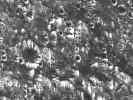
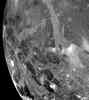
Ganymede’s surface is a roughly equal mix of two types of terrain: very old, highly cratered dark regions (left), and somewhat younger (but still ancient) lighter regions marked with an extensive array of grooves and ridges (right). Their origin is clearly of a tectonic nature, but the details are unknown. In this respect, Ganymede may be more similar to the Earth than either Venus or Mars (though there is no evidence of recent tectonic activity).
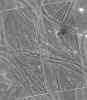
Evidence for a tenuous oxygen atmosphere on Ganymede, very similar to the one found on Europa, has been found recently by HST (note that this is definitely NOT evidence of life).
Similar ridge and groove terrain is seen on Enceladus, Miranda and Ariel. The dark regions are similar to the surface of Callisto.
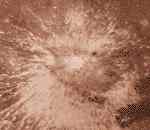
Extensive cratering is seen on both types of terrain. The density of cratering indicates an age of 3 to 3.5 billion years, similar to the Moon. Craters both overlay and are cross cut by the groove systems indicating that the grooves are quite ancient, too. Relatively young craters with rays of ejecta are also visible (left).
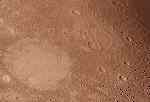
Unlike the Moon, however, the craters are quite flat, lacking the ring mountains and central depressions common to craters on the Moon and Mercury. This is probably due to the relatively weak nature of Ganymede’s icy crust which can flow over geologic time and thereby soften the relief. Ancient craters whose relief has disappeared leaving only a “ghost” of a crater are known as palimpsests (right).
Galileo’s first flyby of Ganymede discovered that Ganymede has its own magnetosphere field embedded inside Jupiter’s huge one. This is probably generated in a similar fashion to the Earth’s: as a result of motion of conducting material in the interior.
More about Ganymede
- more images
- Ganymede from Satellites of the Outer Planets
- from JPL
- HST detection of ozone on Ganymede
- Fact sheet from the Galileo mission pages
Open Issues
- What processes created the light ridge and groove terrain?
- Why are Ganymede and Callisto so different?